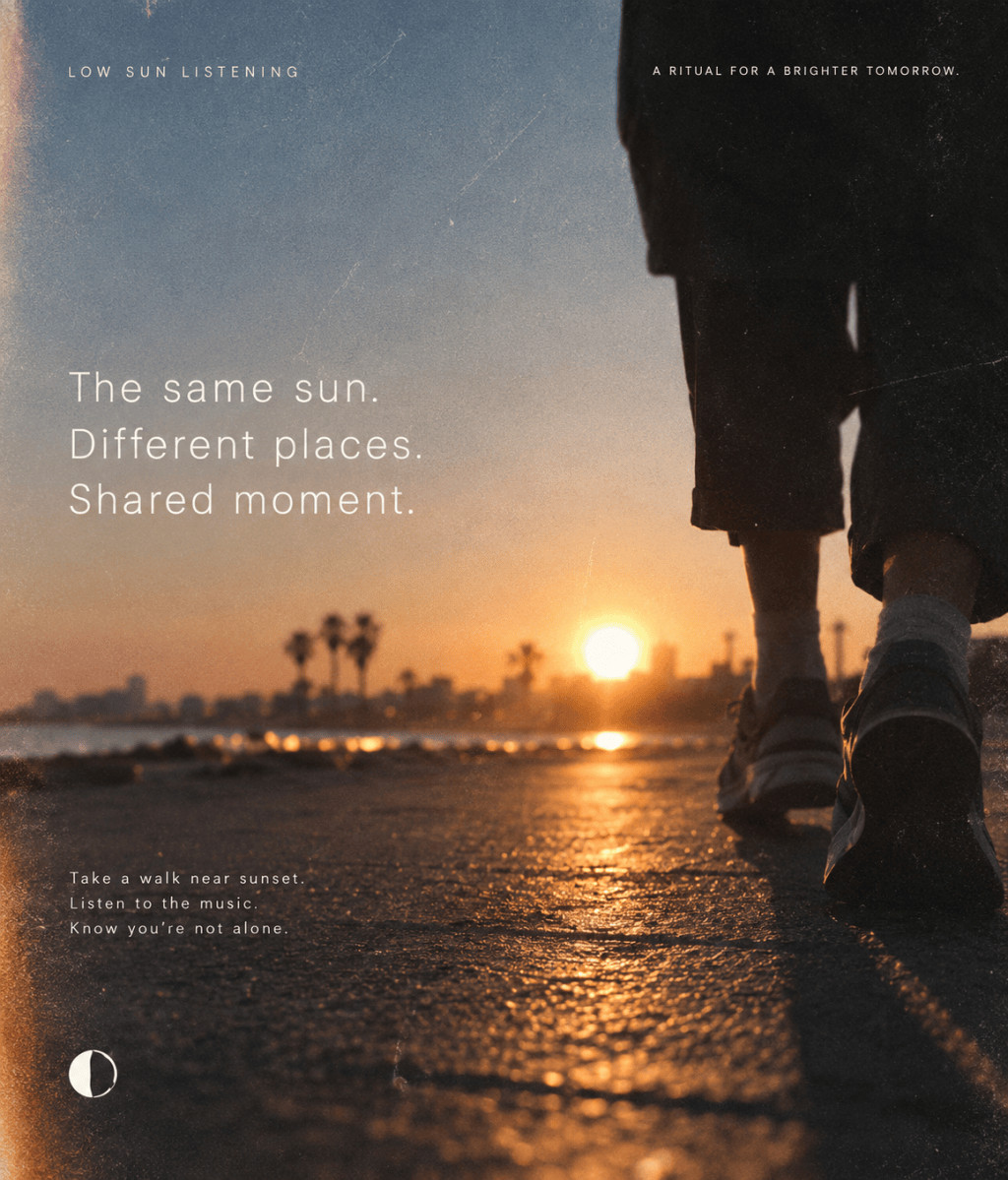
Low Sun Listening began with a simple idea: take a walk near sunset, listen to music chosen for the moment, and know that somewhere else another person may be participating in the same ritual.
There is technology underneath this experience.
A phone determines the time. A music service delivers the songs. An automation can begin the playlist. A website explains the practice. People can discover the experience through social media. Even the process of developing Low Sun Listening has involved artificial intelligence.
But technology is not the destination.
It is the invitation.
Beyond the Promise of Doom
Much of the conversation about emerging technology is framed as a choice between two futures.
In one, technology saves us. Everything becomes faster, smarter, more efficient, and more connected.
In the other, technology destroys something essential. Artificial intelligence replaces human creativity. Automation replaces human work. Screens replace physical experience. Connection becomes isolation.
Both stories can make technology seem inevitable.
Low Sun Listening begins somewhere else.
Instead of asking what technology will inevitably do to us, we can ask:
What do we want technology to make possible?
That is a much smaller question—and perhaps a more useful one.
A Phone Can Point You Toward the Sky
A smartphone can be a device that keeps us indoors, competing for our attention.
It can also tell us when the sun is approaching the horizon.
Those are two very different uses of the same technology.
Low Sun Listening uses digital tools to create a reason to step away from the digital world. The screen helps establish the moment. The music creates continuity. Then the experience moves somewhere else: outside, into changing light, movement, weather, sound, and shared attention.
The technology becomes almost invisible.
That is intentional.
The goal isn’t to spend more time with technology.
The goal is to use technology to become more attentive to something that technology cannot fully replace: being somewhere.
AI as a Creative Instrument
Artificial intelligence introduces another layer to this question.
I use AI as a creative and thinking tool—not as a replacement for having ideas, making judgments, or deciding what matters.
It can help me explore possibilities, identify assumptions, organize information, develop prototypes, and see a project from another perspective.
But an AI system doesn’t decide why Low Sun Listening should exist.
It doesn’t decide that sunset is worth noticing.
It doesn’t take the walk.
It doesn’t experience the transition from daylight into evening.
Those parts remain human.
This distinction matters.
The interesting question isn’t whether artificial intelligence can produce something.
It is whether we can use it to help produce something worth experiencing.
Technology Can Become a Folkway
There is another possibility between technological utopia and technological collapse.
Technology can become part of culture.
People can develop rituals around it. They can adapt it, misuse it, reinterpret it, and turn it into something the original designers never imagined.
A calendar reminder can become a tradition.
A playlist can become a gathering.
A website can become a doorway.
An automation can become a ritual.
A piece of software can become part of a new way of experiencing an old thing.
Low Sun Listening is an experiment in that direction.
It asks whether contemporary technology can help us create new rituals around something ancient and reliably available:
the setting sun.
The Human Remains the Point
There is no promise here that technology will save humanity.
There is no promise that it will destroy humanity, either.
There is only an experiment.
Can a phone help someone notice the evening?
Can a playlist help strangers feel connected without needing to be in the same place?
Can artificial intelligence help a person develop an idea without taking ownership of the experience?
Can digital infrastructure create opportunities for artists while still directing attention toward the physical world?
I don’t know yet.
That’s why I’m experimenting.
Low Sun Listening is not an argument against technology.
It is an argument against assuming that technology has to be the center of the experience.
Technology can be the instrument.
The ritual can be the experience.
And the human being can remain the point.
 Low Sun Listening | A Transennial Installation
Leave a comment